
Executive Summary
- Industry: Health Analytics
- Business Problem: 30-Day Hospital readmissions increase operational costs, strain resources, and negatively impact patient outcomes and reimbursement under value-based care models.
- Objectives: Identify patients at high risk of readmission early and provide proactive intervention strategies before discharge.
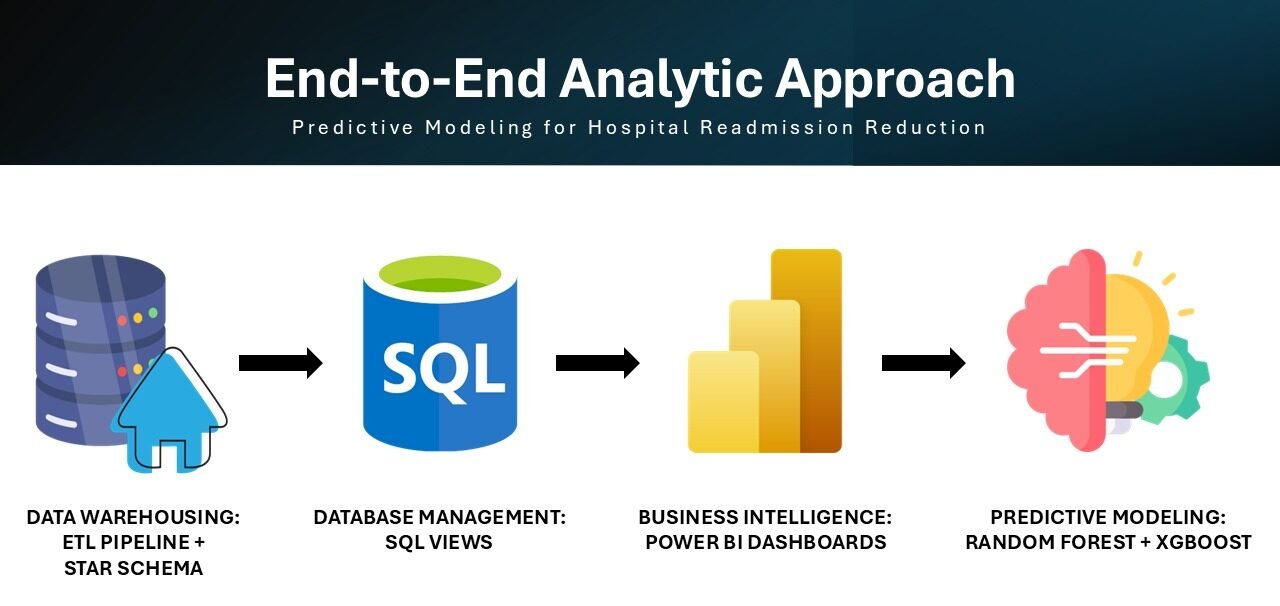
- Data and Method: New York SPARCS inpatient discharge data analyzed using SQL for data management, Python for data preprocessing, EDA, and predictive modeling, and Power BI for visualization.
- Key Insights: Elderly patients, public insurance holders (especially Medicare), and high severity or high mortality clinical profiles and major conditions (infectious, respiratory, circulatory) have the greatest readmission risk.
- Business Impact: Enabled targeted transitional care planning and operational support for reducing readmission risk and improving resource allocation and value-based care.
Business Problem
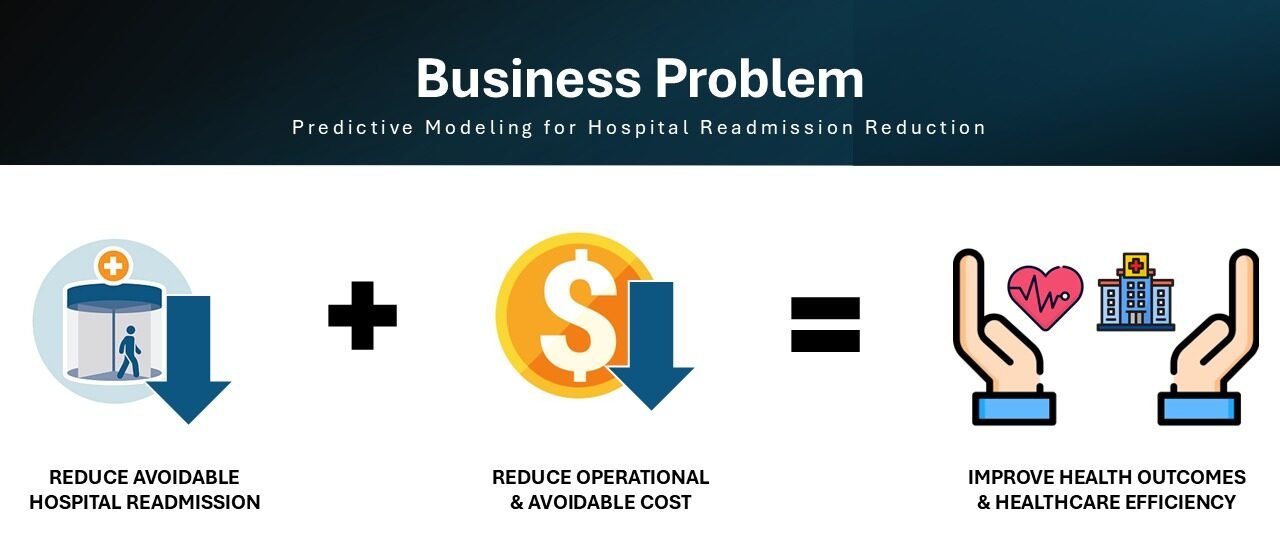
30-Day hospital readmission is a critical measure of quality inpatient care, patient safety, post-discharge outpatient care, and overall hospital performance. As a result, healthcare organizations face increasing pressure to reduce avoidable readmissions while maintaining quality of care. High readmission rates not only strain hospital capacity and increase operational costs but also signals potential gaps in care delivery and coordination, discharge planning, and patient education. This highlights the need for data-driven solutions to
- identify high-risk patients likely to be admitted,
- understand patterns and trends in clinical, operational, and demographic risk factors,
- tailor transitional care management resources effectively.
Objectives & KPIs
The analytical framework was designed to support the following objectives:
- Uncover key risk drivers of readmission, including trends and patterns
- Detect high-risk patient segments prior to discharge
- Support targeted intervention and care planning decisions.
Primary KPIs include:
- 30-Day readmission rate
- Length of stay
- Comorbidity risk indicators
- Facility performance indicators
- Clinical risk and demographic indicators
Analytical Approach
Leveraging data management, data analytics, business intelligence, and machine learning techniques, the team developed:
- SQL-based star schema data warehouse, data modeling, and analytics views
- Exploratory data analysis to identify trends and correlations
- Feature engineering to capture utilization and clinical risk patterns
- Predictive modeling to estimate readmission likelihood
- Business intelligence dashboards to communicate insights
This analytical framework emphasized interpretability and decision support, delivering a practical solution for integrating risk prediction into discharge workflows, guiding targeted transitional care, and supporting ongoing quality improvement decisions.
Key Insights
- Elderly age groups (70+ and 50–69) experience the highest readmission risk.
- Medicare beneficiaries recorded the highest readmission risk in terms of payer mix, followed by other public insurance holders (Department of Corrections, Federal/State/Local/VA)
- Major Diagnostic Categories such as Infectious diseases, Respiratory diseases, toxic effects of drugs, and poorly differentiated neoplasms are the few conditions that drive high readmission rates. Similarly, Pregnancy/childbirth, Circulatory, Newborn, and Musculoskeletal/connective tissue conditions are among the highest inpatient visits and hospital utilization.
- Patient with extreme severity and mortality risk cases are at significantly high risk of readmission and clinical deterioration.
- Average LOS is 6 days versus 12 days for readmitted patients, suggesting that readmissions are associated with substantially higher resource utilization.
- Manhattan, Kings, Nassau, and Queens are NY regions accounting for the highest absolute number of readmissions, while Orleans, Genesee, Steuben, and Cattaraugus counties have the highest readmission rates (above 20%). Respiratory and circulatory conditions are the main clinical drivers of readmissions across all NY regions.
- Some facilities are disproportionately struggling with readmissions, indicating variability in practices and performance.
Operational and Clinical Decision Support
Based on the findings, the analysis recommended these actions:
- Implement targeted transitional care (medication reconciliation, early followup appointments, home or telehealth checkins) for high-risk patient segments.
- Develop geriatric care pathways that include discharge education tailored to cognitive and functional status, caregiver engagement, fall risk, and polypharmacy reviews.
- Prioritize care management and readmission reduction programs based on payer mix, predicted risk and complexity levels.
- Partner with payers to design value-based programs, for instance enhanced transitional care and disease management for high-risk cohorts.
- Implement MDC-specific standardized transitional care pathways, discharge planning, and patient education.
- Implement targeted public health programs for MDCs with high hospital utilization, including remote monitoring for heart failure, pneumonia, and Chronic Obstructive Pulmonary Disease (COPD).
- Evaluate LOS and readmission risk metrics together to identify high-value intervention points, targeting patients with unexpected longer stays for intensive discharge planning.
- Focus outreach and interventions first in high readmission utilization counties to maximize impact, employing dashboard for performance tracking.
- Use high-performing facilities as benchmarks to implement best practices (discharge workflows, patient education, transitional care models) for underperforming facilities.
- Track facility and service area level intervention performance using dashboard and support underperforming sites with targeted quality improvement projects.
Business Impact
The predictive modeling and decision support components of the project demonstrate substantial potential clinical and operational benefits.
- Reduction of 30-day avoidable readmissions by early detection and tailored intervention on highest-risk patient segments.
- Improved operational efficiency through effective processes, hospital utilization, and resource allocation.
- Enhanced stakeholder monitoring of readmission drivers and risk patterns.
Team Contributors: Dev Arora, Tony Lordson, and Anil Kumar Swamy Bandaru