
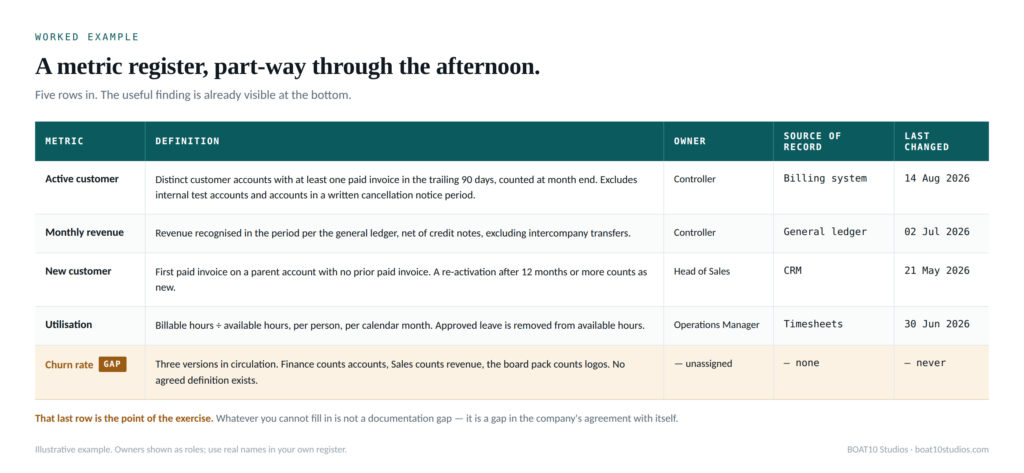
A metric register is simply a spreadsheet with five columns. It is also one of the highest return artifacts in analytics.
This article outlines the complete method. You do not need a consultant, a tool, or a budget, just an afternoon and a willingness to have two or three uncomfortable conversations.
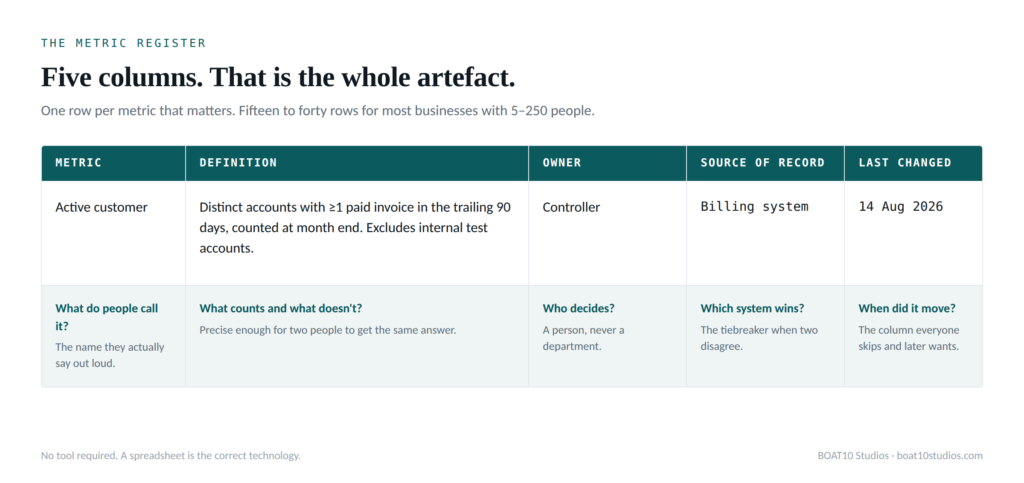
The five columns
Metric: The name as people actually say it in your business. If everyone says “active clients,” write that, not “Active Client Count (Monthly).” The register is meant to be recognized.
Definition: One or two sentences precise enough that a new hire could apply the rule without asking anyone. This column does the work. It must state what is included, what is excluded, the time basis, and how edge cases are handled.
Owner: A person’s name. Not “Finance” or “the leadership team”. The owner is who decides what the metric means and who approves a change to it.
Source of record: The one system that is authoritative for this metric. When another system disagrees, this one is right and the other one gets fixed.
Last changed: A date, and ideally a one-line note about what changed. This is the column people skip and later wish they had kept.
Choosing which metrics go in
Start with the metrics that appear in decisions, not the metrics that appear in dashboards. A practical filter is: any number that shows up in a board pack, a funder/investor report, a regulatory submission, a compensation calculation, or a recurring management meeting.
For most small businesses between 5 and 250 people, that is fifteen to forty rows. If your list runs past sixty, you are cataloguing rather than governing, and the register will die of its own weight.
Writing a definition that holds up
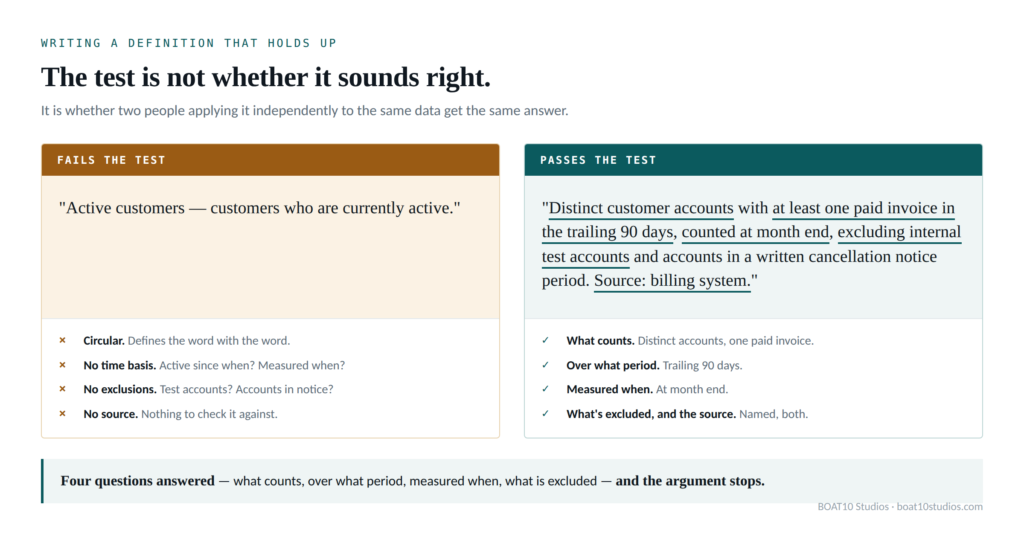
The test of a definition is not whether it sounds right, it is whether two people applying it independently to the same data arrive at the same answer.
Weak: Active customers: customers who are currently active.
Strong: Active customers: distinct customer accounts with at least one paid invoice in the trailing 90 days, counted at month end, excluding internal test accounts and accounts in a written cancellation notice period. Source: billing system.
The second version answers the four questions that cause disputes: what counts, over what period, measured when, and what is excluded.
Expect the arguments, they are the point
Somewhere around the fourth or fifth row, this stops being an administrative task. Sales will define a customer at the point of signature, finance at the point of payment. Operations will count a service delivered when the work finished, billing when it was invoiced. In healthcare settings, three different departments will each have a defensible answer for what a resident day is.
Nobody is being obtuse. Each definition evolved because it was correct for that team’s purpose. What has never happened is a decision about which one is the company’s answer. That decision is the actual product of the exercise. The spreadsheet is just where you record it.
When a genuine conflict surfaces, you have two honest options: pick one definition and have the other team adapt, or keep both as two clearly named metrics with two definitions and two owners. What you cannot do is keep both under one name, that is where you started.
The afternoon of, step by step
First 30 minutes: List the metrics. Do not define anything yet, just get the names down. Pull from your last board pack and your last three management meetings.
Next 60 minutes: Fill in owner and source of record for every row. This is fast and it surfaces the problems immediately: rows with no obvious owner, and rows where nobody can name an authoritative system, are your highest-risk metrics.
Next 90 minutes: Write definitions for the top ten only. Depth beats coverage. Ten precise definitions are worth more than forty vague ones.
Final 30 minutes: Circulate it. Ask each named owner to confirm or correct their rows in writing. The confirmations are what turn a document into governance.
Keeping it alive
A register that is not maintained becomes misleading, which is worse than not having one.
Three habits keep it alive, and all three are cheap.
- Review it once a quarter for fifteen minutes.
- Require that any change to a definition is recorded with a date and the owner’s approval before it is implemented anywhere.
- And when a new report is built, check whether its metrics exist in the register first; if they do not, add them before the report ships.
That last habit is the one that compounds. It means your register grows in step with your reporting rather than falling permanently behind it.
What it gets you
Within a quarter you should notice three things:
- Recurring validation and cross-checking arguments get shorter, because there is a document to point at rather than two opinions.
- Onboarding gets faster, because a new analyst can read the register instead of interviewing five people.
- And audits, investor reviews and diligence requests get dramatically less painful, because the first thing every reviewer asks for is exactly this.
You will also find out something less comfortable, which of your numbers nobody can actually define. That finding alone is usually worth the afternoon.